Showing posts with label food. Show all posts

Monday, June 11, 2012

What is a Koffietafel?....Tulips for Augusta

 Here's interesting passage from Tulips for Augusta written in 1971.

This little paragraph has had me doing all kinds of online research just because it drives me craaaaaaazy not to know something.
"....By the time all these delights had been tried on and tasted and admired, it was lunch time. The old ladies had Koffietafel at noon each day--a meal of rolls and different sorts of bread, with cheese and sausage and cold meat and a salad arranged before each place upon a small silver dish--and of course, coffee. Augusta, who was hungry after her journey, ate with a healthy appetite which pleased the aunts, who were, as far as she could remember, the only members of her family who had not, at one time or another, made some reference to her delicate plumpness."

I looked up Koffietafel and the literal translation seems to be coffee and table but it does not refer to furniture. According to the Dutch Wiki a Koffietafel is:
Een koffietafel is een eenvoudige broodmaaltijd met koffiekoeken of eenvoudig belegde sandwiches (bijvoorbeeld enkel kaas en hesp). Als drank serveert men koffie en thee. Door de eenvoud is een koffietafel geschikt voor een groot aantal personen, bijvoorbeeld na afloop van een begrafenis. Dit noemt dan ook wel een rouwtafel. Maar ook voor andere gelegenheden biedt men een koffietafel aan. Bijvoorbeeld als men thuis gasten ontvangt, de gastvrouw of -heer wil dan niet te lang in de keuken vertoeven en kan langer bij het bezoek aanwezig zijn. Of op een congres, waarbij deelnemers een lichte maaltijd kunnen appreciëren.
Indien een koffietafel uitgebreid wordt met nog andere etenswaren en in buffetvorm wordt aangeboden, dan spreekt men soms van een Brabantse koffietafel. Dit begrip is afkomstig uit Noord-Brabant en was een overvloedige maaltijd, die men opdiende aan de buren als men een varken had geslacht.

Ooops.... do you not read Dutch?...lol..me neither. When I put this through google translate it said:
A coffee table is a simple snack with coffee cakes or simple sandwiches (for example, only ham and cheese). Serve as a drink of coffee and tea. Their simplicity is a coffee table for many people, for example after a funeral. This therefore calls a funeral table. But also for other occasions, we offer coffee to. For example if we receive guests at home, the hostess or gentleman will not dwell too long in the kitchen and can no longer be present during the visit. Whether at a conference, where participants can appreciate a light meal.
If a coffee table is extended with additional food and buffet is offered, then we sometimes speak of a Brabant coffee. This concept comes from Ontario and had a sumptuous meal, which can opdiende to neighbors if a pig had sex .

Okay, that's interesting and makes sense given what was written in the book but that last part ...."which can opdiende to neighbors if a pig had sex". I have no idea what that's about. Does anyone that speaks/reads Dutch know if the translation is bad or what???

 Ooooooo.....I just found an interesting blog where the author talks about  a "Koffietafel":
"Coffee is a big deal in Flemish life. One of the major family events, a funeral, is not complete without a "koffietafel", which is the name for the reception that follows the funeral. The "koffietafel" is usually held in a church hall and includes pastries, rolls with cheese and ham, and of course, numerous cups of coffee. The pastries, which you can also buy every day at local bakeries, are called "koffiekoeken". If you are female and you go visit your neighbor lady you always get offered a cup of coffee and this visit is referred to as "koffiekletsen". When you go to the hairdresser you are always offered a cup of coffee. And this can be dangerous if you are trying to watch your diet as all these friendly cups come with a cookie, or in some places (mostly nicer cafes), a tiny cup of whipped cream and a small slice of pound cake!"


 Doing further research I found this information on a site that seems to be run by tourist businesses. It said:


"A large percentage of the restaurants in Amsterdam include a "koffietafel" on their lunch-time menu, even when they specialize in hot meals. It's rarely difficult, therefore, to find a "koffietafel," and it's also good to remember that a koffietafel is an unusually inexpensive lunch to have
Typical of what you'll receive and pay is the koffietafel served at the moderately-priced V.A.M.I. Restaurant, 171 Kalverstraat, in the heart of the shopping section of Amsterdam, for an enormous koffietafel lunch, including a hot meat croquette and milk or coffee

Another koffietafel-serving place? Try the huge Ruteck's Restaurant, 11 Rembrandtsplein (which is not to be confused with the smaller self-service Ruteck's at 2 Rembrandtsplein), where the koffietafel is referred to by its alternate name, a "twaalfuurtje" (a 12 o'clock bread-lunch), and consists of three pieces of bread, a roll, ham, roast beef, cheese, a currant leaf, a "tid-bit of Italian salad," and a choice of coffee, tea or milk. 

Alternately still, Ruteck's offers a "Brabantse koffietafel", which includes all the above items plus an egg, an extra slice of bread, fruit for dessert, and a second glass of coffee or milk.
 
For an even swankier koffietafel, try the one served at the quiet, genteel Formosa Tearoom, 15 Spui (about 20 yards from the Kalverstraat), or the variety of the restaurant at the American Hotel, overlooking the Leidseplein, which offers (from noon to 2 only): an assortment of white, rye, brown and gingerbread, a roll, a bun, rusks and butter, cold meat, a "Ravigote sauce shell" with salad or a hot croquette, Gouda cheese, jam, coffee, tea, milk or chocolate!"


Okay, so apparently, a Koffietafel is an event more than an actual food. Basically, it's seems to be used to describe a lunch or brunch or afternoon tea like meal. Good to know.
Now that that has been settled, here's a recipe for a currant bread that is said to be served at a traditional koffietafel. Happy Baking!
 

Currant Bread (Krentenbrood)

Ingredients
1 3/4 cups milk, 120-130 degrees
3 tablespoons butter
3 tablespoons sugar
1 egg
1/2 teaspoon salt
2 1/4 teaspoons yeast, dry
1/4 cup water, 110 degrees
5 cups flour
2 cups currants
1 cup raisins
Directions
Mix milk, butter, sugar, egg and salt. Mix yeast in water. Let stand 5-10 minutes until dissolved. Add to first mixture. Gradually add flour. Knead. Cover and let stand in a warm place for an hour. Punch down and add currants, raisin and candied, chopped lemon peel, if desired. Shape into 2 loaves. Place in greased and floured loaf pans. Cover with damp cloth and let rise again in a warm place for 1 hour. Bake at 350 degrees for one hour or until brown.


Monday, September 20, 2010

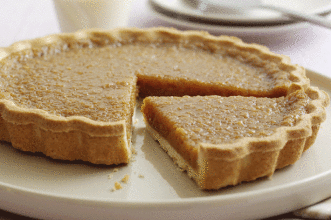
Treacle, Treacle Little Tart.....about the frequently mentioned dessert in Betty's Books

What is treacle???
According to the folks at wiki:

Treacle is any syrup made during the refining of sugar cane and is defined as "uncrystallized syrup produced in refining sugar". Treacle is used chiefly in cooking as a form of sweetener or condiment.
The most common forms of treacle are the pale syrup that is also known as golden syrup and the darker syrup that is usually referred to as dark treacle or black treacle. Dark treacle has a distinctively strong flavour, slightly bitter, and a richer colour than golden syrup, yet not as dark as molasses. Golden syrup is the main sweetener in the Treacle Tart.

In popular culture

In chapter 7 of Lewis Carroll's Alice's Adventures in Wonderland, the Dormouse tells a story of Elsie, Lacie and Tillie living at the bottom of a well, which confuses Alice, who interrupts to ask. "The Dormouse again took a minute or two to think about it, and then said, 'It was a treacle-well.'" When Alice remonstrated, she was stopped by the Mad Hatter's analogy: "You can draw water out of a water-well, so I should think you could draw treacle out of a treacle-well." Alice said very humbly, "I won't interrupt you again. I dare say there may be one." This is an allusion to the so-called "treacle well", the curative St. Margaret's Well at Binsey, Oxfordshire.
In Series 3 episode 6 of Jeeves and Wooster, Bertie Wooster, while trying to make off with an unsightly painting, attempts to use treacle and brown paper to muffle the sound of broken glass. He is foiled, however, by the treacle's stickiness.
Harry Potter also often eats treacle tart in the Harry Potter book series by J.K. Rowling. Treacle tart is also mentioned in Agatha Christie's murder mystery novel, 4:50 from Paddington , as young Alexander Eastley's favourite dessert

Hmmmm....all this interesting Treacle information. They even mention treacle in popular literature BUT they managed to miss the appearance of treacle tarts, frequently, in our dear Betty's books. A horrible oversight!!!

Yes, fellow Betty lovers, I am sure that you have noticed the frequent whipping up of a quick treacle tart or as is mentioned in A Small Slice of Summer, the eating of the tart because it's ....well dare we say it, cheap and filling....
Letitia wandered along the counter with her tray, looking for something cheap and nourishing. She had bought a dress on her last days off and her pocket was now so light that buying her meals had become a major exercise in basic arithmetic.
She chose soup, although it was a warm june day, a roll to go with it and a slab of treacle tart, because starch was filling and even though it was fattening too she was lucky enough not to have that problem, being possessed of a neat little figure which retained its slender curves whatever she ate. she paid for these dainties at the end of the counter and went to join her fellow staff nurse, Angela Collins, who cast a sympathetic eye at the contents of her tray, said fervently,  "Thank God, it's only a week to pay-day," and addressed herself to her own, similar meal.

 Now, dear Bettys. we ask..."What is a treacle tart?"
According to WiseGeek  (I thought I would change up authorities to keep you on your toes):
Treacle tart is a popular dessert in the UK. It has become somewhat of a curiosity in other countries due to its frequent mention in the Harry Potter books. Treacle tart is in fact, Harry’s favorite dessert.
For most anyone not British, great misunderstanding exists about treacle tart. Many assume that it is made with molasses, which is often called treacle in the UK. Actually treacle tart is made with golden syrup, a by-product of sugar making, like molasses, but more similar in taste and texture to honey. Golden syrup may also be referred to as treacle in the UK.
One may find golden syrup in the US in international food stores, and it can be purchased on the Internet so one can make the perfect treacle tart. If one cannot obtain golden syrup, honey is a close alternative ingredient.
Most treacle tarts begin with a very rich shortbread pastry as a base, usually containing butter, flour and an egg yolk added so that the pastry crumbs adhere to each other. The golden syrup is combined with breadcrumbs, lemon juice, and occasionally spices like ginger to form the filling of treacle tart. The tart is then topped with several strips of the pastry to give it a rich, crispy finish.
The treacle tart bakes for about 45 minutes, and temperatures may vary according to recipes. A treacle tart may be baked in small tins for individual tarts, or it may be baked in a larger pie tin to serve in slices.
Treacle tart has a consistency similar to pecan pie, though it usually does not contain eggs in the filling and is less gelatinous. It is slightly stickier. It can be served hot, warm, or cold, and may be garnished with whipped cream, or ice cream. It is a very sweet dish, and those unaccustomed to such sweetness may find it overly sweet.


 This is celebrity chef Gordon Ramsay’s recipe for treacle tart. It comes from his cookbook Gordon Ramsay’s Great British Pub Food .  I am told that the tart tastes even better a day after baking, when the breadcrumbs have had time to absorb the filling. Serve slices with whipped cream or crème fraiche.

Gordon Ramsay’s Treacle Tart – Recipe

Ingredients
  • 300g sweet flan pastry (see below)
  • 450g golden syrup
  • 85g white breadcrumbs
  • Finely grated zest and juice of 1 lemon
  • ½ tsp ground ginger
  • 60g butter, melted
  • 3 large egg yolks
  • 70ml double cream
  • ½ tsp black treacle
Ingredients to make the sweet pastry – (makes about 500g-you can freeze any excess for a day or so)
  • 125g unsalted butter, softened to room temperature
  • 90g caster sugar
  • 1 large egg
  • 250g plain flour
  • 1 tbsp ice-cold water (if needed)
Method
To make the sweet pastry:
  1. Place the butter and sugar in a food processor and whiz until just combined. Add the egg and whiz for 30 seconds.
  2. Tip in the flour and process for a few seconds until the dough just comes together. (Do not over-process or it will become tough.) Add a little cold water if the dough seems too dry.
  3. Knead the dough lightly on a floured surface and shape into a flat disc. Wrap in cling film and chill for 30 minutes before rolling out.
To make the treacle tart:
  1. Roll out the pastry on a lightly floured surface to a large round, the thickness of a £1 coin. Use to line a 23-24cm round shallow tart tin, with removable base, leaving some excess pastry overhanging the rim. Leave to rest in the fridge for 30 minutes. Meanwhile, preheat the oven to 190°C/Gas 5.
  2. Line the pastry case with baking paper and dried or ceramic baking beans and bake ‘blind’ for 15-20 minutes or until the base is cooked through. While still warm, cut off the excess pastry to level with the rim of the tin. Lower the oven setting to 140°C/Gas 1.
  3. For the filling, gently heat the golden syrup by immersing the bottle or tin in a bowl of hot water for a few minutes. Mix the breadcrumbs, lemon zest and ground ginger together in a large bowl and make a well in the middle.
  4. Pour in the warm golden syrup and add the butter, egg yolks, cream, treacle and lemon juice. Stir well to mix.
  5. Pour the filling into the pastry case. Bake for 30-40 minutes until the top has just set, but the centre is slightly wobbly when you shake the tin gently. It should still feel slightly soft in the centre.
  6. Let the tart cool completely before slicing and serving, with cream or crème fraiche.

recipe found at Suite101: Gordon Ramsay's Treacle Tart Recipe: How to Make Traditional English Pastry